
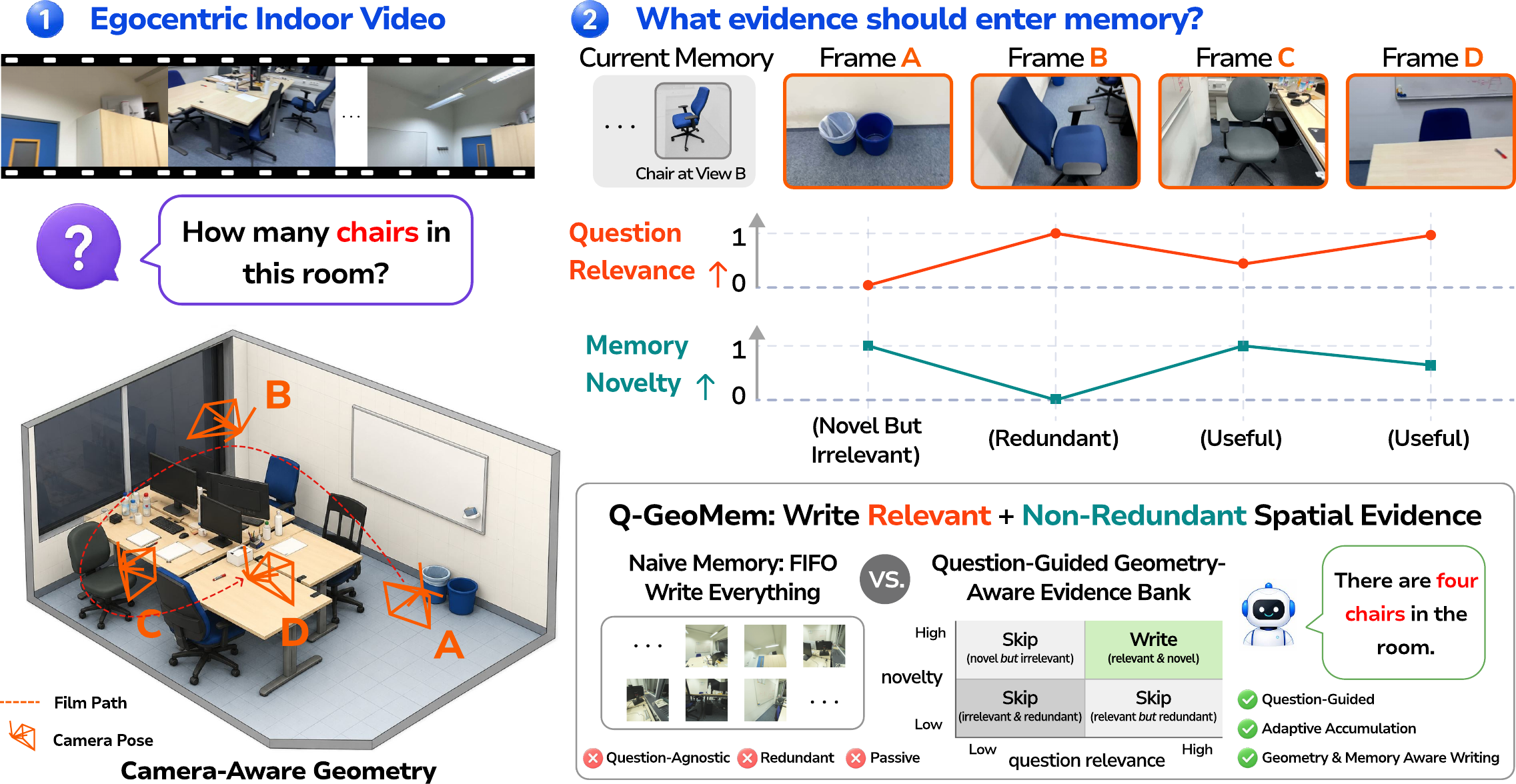
Memory‑Centric Formulation
We recast video spatial reasoning so that camera‑conditioned geometry, question relevance, and novelty jointly decide what evidence should be retained.
Video spatial reasoning requires accumulating viewpoint‑dependent evidence over time while retaining information useful to the question being asked. Existing spatial video‑language models improve geometric perception and long‑range context modeling, but often treat memory as a generic temporal cache, which can introduce redundant or irrelevant geometry and weaken long‑horizon reasoning. We propose Q‑GeoMem, a question‑guided geometric memory framework for video spatial reasoning. Q‑GeoMem injects camera‑conditioned geometry into visual tokens and maintains two complementary memories: a Fine‑Grained Context Bank for recent dense features and camera states, and a Semantic‑Geometric Evidence Bank for compact long‑range evidence. Each candidate frame is assigned a calibrated Q‑Former‑based question relevance score, while novelty and evidence utility are recomputed with respect to the active evidence bank. The resulting relevance–novelty utility is used for capacity‑based replacement and as an attention bias during memory reading. During reasoning, both memories are read before update and adaptively fused with the current frame representation. Experiments on VSI‑Bench and VSTI‑Bench show that Q‑GeoMem achieves state‑of‑the‑art performance among evaluated spatial reasoning models, and ablations verify the contribution of the proposed evidence scoring mechanism.
We recast video spatial reasoning so that camera‑conditioned geometry, question relevance, and novelty jointly decide what evidence should be retained.
Camera‑guided geometry fusion, a Fine‑Grained Context Bank for recent dense evidence, and a Semantic‑Geometric Evidence Bank for compact long‑range evidence, with adaptive fusion of memory readouts.
Selecting memory entries by both question relevance and novelty yields a more effective memory mechanism than treating memory as a chronological cache.
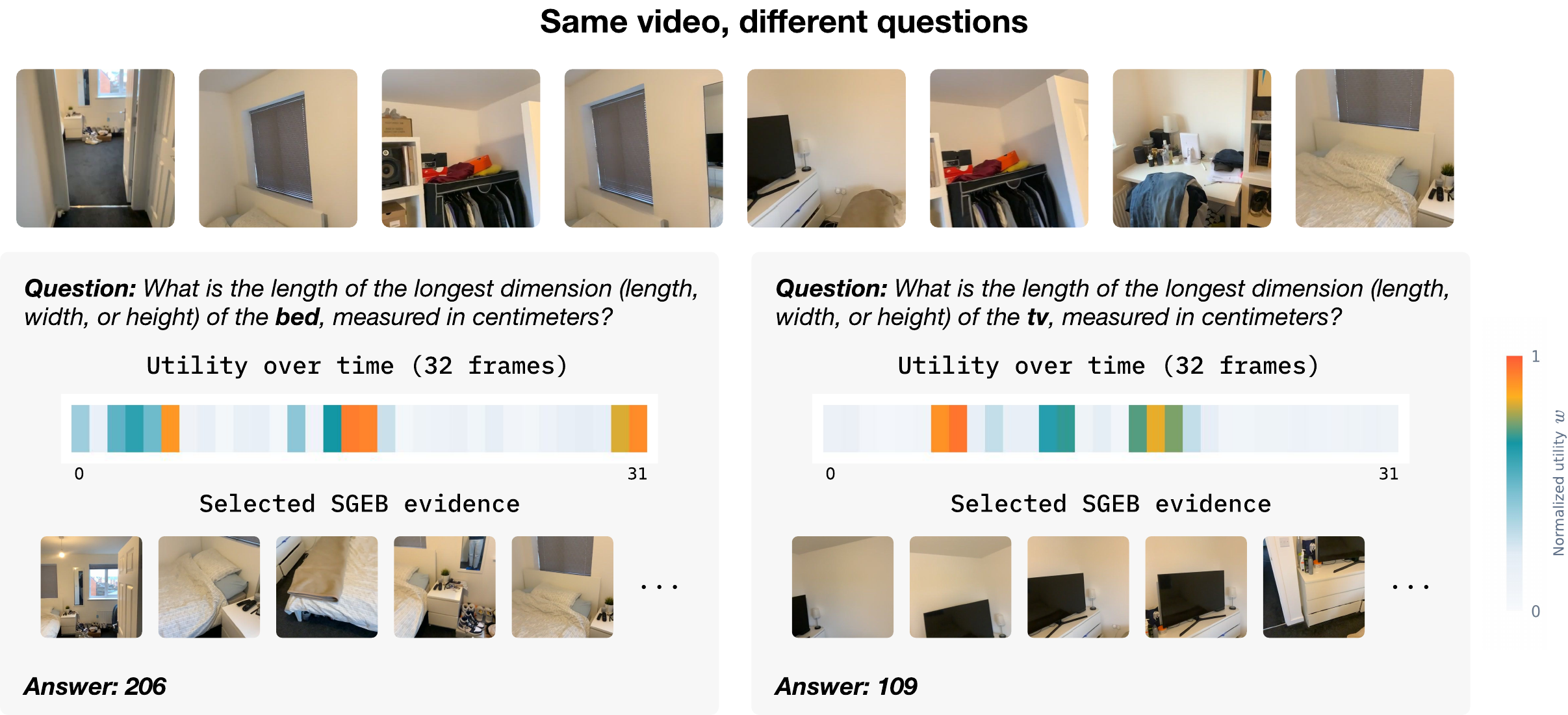
The same egocentric video, viewed through multiple lenses of Q‑GeoMem. Switch the question to watch per‑frame relevance reshape, then step through streaming to watch novelty drive eviction in the evidence bank.
Each video keeps its own 32-frame axis. Switch questions within a video to watch the relevance curve interpolate between object-specific evidence.
ri — how useful frame i is for the selected question
ri — how useful frame i is for the selected question
For the Bed dimension question, stream the video frame‑by‑frame. Each candidate is scored by
novelty ν = 1 − max sim against the active bank;
the relevance–novelty utility w = r·ν drives capacity‑based replacement.
K = 6 · 0 stored
νt
utility wt = r·ν right scale
evicted entry
Camera‑guided geometry fusion injects spatial cues into frame tokens; two complementary banks then read evidence before writing, and adaptive fusion combines both readouts with the current frame.
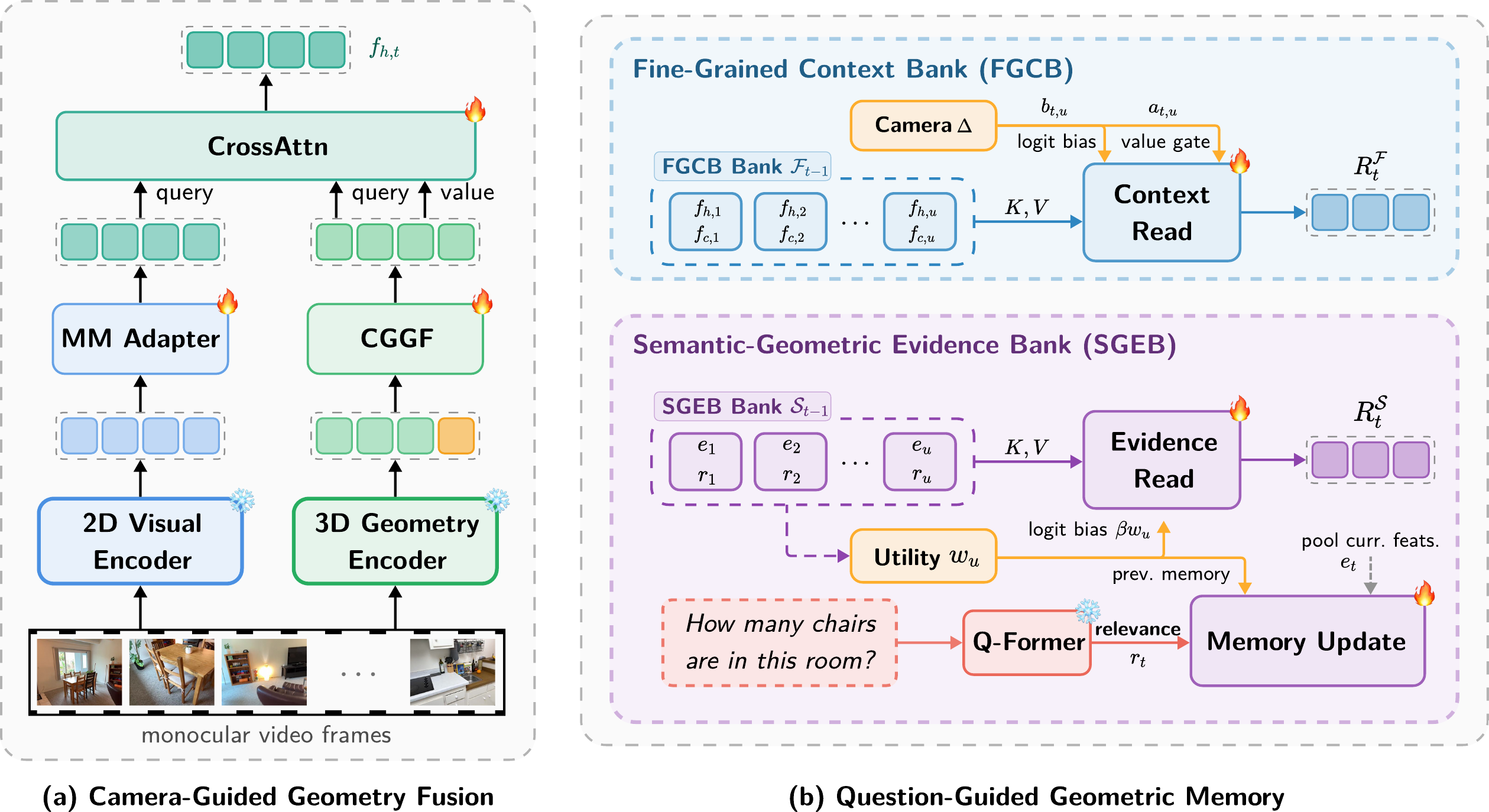
rt and bank‑relative novelty νt compose the
evidence utility wt.
The visual stream attends to camera‑conditioned geometry through a reliability gate, so that both banks operate on spatially grounded features fh,t.
A sliding window of recent dense features and camera states. Camera‑feature differences modulate the read attention, supporting local, view‑dependent details.
A fixed‑capacity bank of compact entries. Calibrated relevance r and novelty ν form the utility w = r·ν, used as a read‑time attention bias and for eviction.
Q‑GeoMem achieves the best average score among evaluated spatial reasoning models on VSI‑Bench and VSTI‑Bench, while the same memory design transfers to out‑of‑distribution spatial, 3D QA, and long‑form video benchmarks.
| Method | Avg. | Obj. Cnt. | Abs. Dist. | Obj. Size | Room Size | Rel. Dist. | Rel. Dir. | Route Plan | Appr. Order |
|---|---|---|---|---|---|---|---|---|---|
| Gemini‑1.5 Pro | 45.4 | 56.2 | 30.9 | 64.1 | 43.6 | 51.3 | 46.3 | 36.0 | 34.6 |
| InternVL3‑78B | 48.5 | 71.2 | 53.7 | 44.4 | 39.5 | 55.9 | 39.5 | 28.9 | 54.5 |
| VLM‑3R‑7B | 60.9 | 70.2 | 49.4 | 69.2 | 67.1 | 65.4 | 80.5 | 45.4 | 40.1 |
| VLM2‑7B | 68.8 | 72.5 | 59.6 | 70.8 | 69.9 | 69.0 | 87.8 | 52.6 | 68.3 |
| Q‑GeoMem (Ours) | 71.2 | 74.8 | 59.9 | 76.5 | 75.3 | 71.1 | 87.2 | 50.0 | 74.6 |
| Method | Avg. | Cam‑Obj Abs. Dist. | Cam. Displace. | Cam. Mov. Dir. | Obj‑Obj Rel. Pos. | Cam‑Obj Rel. Dist. |
|---|---|---|---|---|---|---|
| GPT‑4o | 38.2 | 29.5 | 23.4 | 37.3 | 58.1 | 42.5 |
| LLaVA‑NeXT‑Video‑72B | 44.0 | 32.3 | 10.5 | 48.1 | 78.3 | 50.9 |
| VLM‑3R‑7B | 58.8 | 39.4 | 39.6 | 60.6 | 86.5 | 68.6 |
| VLM2‑7B | 65.3 | 43.1 | 44.1 | 76.8 | 87.7 | 74.9 |
| Q‑GeoMem (Ours) | 67.8 | 44.3 | 44.6 | 84.0 | 91.0 | 74.9 |
Adding SGEB consistently improves transfer on video spatial reasoning, situated 3D scene QA, and general long‑form video understanding benchmarks.
| Model | SPBench‑MV | MMSI‑Video | SQA3D | VideoMME | EgoSchema |
|---|---|---|---|---|---|
| Q‑GeoMem (w/o SGEB) | 69.03 | 23.97 | 49.43 | 59.77 | 49.81 |
| Q‑GeoMem (Ours) | 72.61 | 25.49 | 50.38 | 60.96 | 53.11 |
| Gain | +3.58 | +1.52 | +0.95 | +1.19 | +3.30 |
| Model | Avg. | Obj. Cnt. | Abs. Dist. | Obj. Size | Room Size | Rel. Dist. | Rel. Dir. | Route Plan | Appr. Order |
|---|---|---|---|---|---|---|---|---|---|
| LLaVA‑NeXT‑Video‑7B ft. (Baseline) | 64.83 | 71.91 | 51.47 | 75.38 | 70.56 | 67.32 | 72.09 | 42.27 | 67.64 |
| Baseline + CGGF | 67.28 | 72.07 | 56.13 | 74.49 | 72.43 | 68.17 | 81.47 | 45.36 | 68.12 |
| Baseline + CGGF + FGCB | 67.92 | 71.70 | 55.97 | 75.47 | 73.75 | 66.48 | 84.62 | 46.91 | 68.45 |
| Baseline + CGGF + FGCB + SGEB | 71.17 | 74.76 | 59.89 | 76.55 | 75.28 | 71.13 | 87.18 | 50.00 | 74.60 |
| Model | VSI Avg. | VSI Short | VSI Mid | VSI Long | VSTI† Avg. | VSTI† Short | VSTI† Mid | VSTI† Long |
|---|---|---|---|---|---|---|---|---|
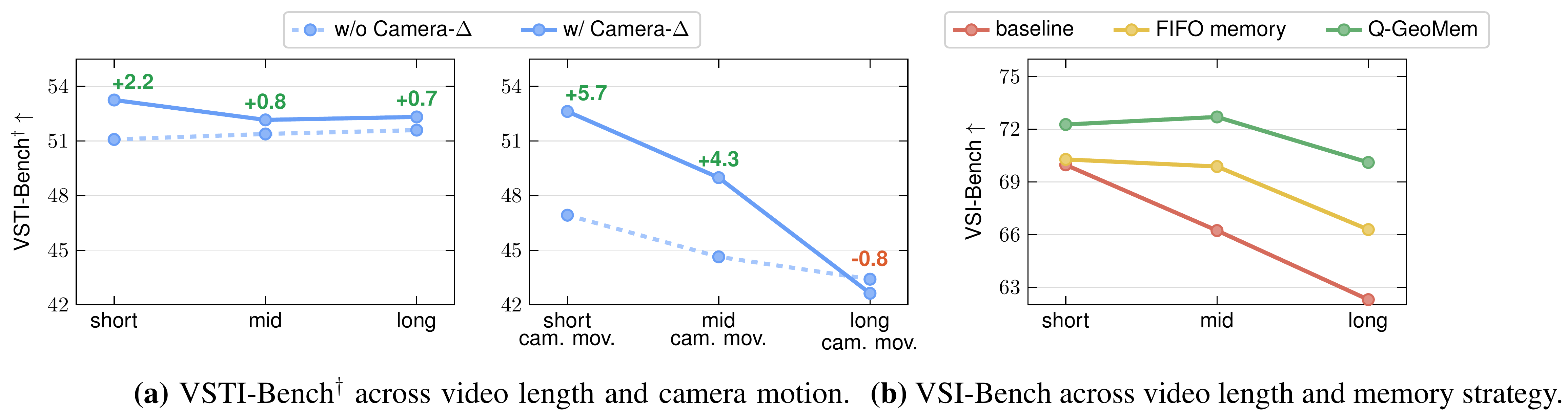
| Q‑GeoMem (w/o SGEB), w/o Camera‑Delta | 66.57 | 68.91 | 67.66 | 64.50 | 51.17 | 51.08 | 51.39 | 51.60 |
| Q‑GeoMem (w/o SGEB) | 67.92 | 70.55 | 69.43 | 65.33 | 52.24 | 53.25 | 52.16 | 52.32 |
| Gain | +1.35 | +1.64 | +1.77 | +0.83 | +1.07 | +2.17 | +0.77 | +0.72 |
| Policy | Update Rule | Read Bias | VSI Avg. | VSI Long |
|---|---|---|---|---|
| FIFO | evict oldest | none | 68.7 | 66.3 |
| QRel‑only | evict min r | βr | 69.3 | 68.2 |
| Novelty‑only | evict min ν | βν | 68.9 | 67.3 |
| Q‑GeoMem | evict min rν | βrν | 71.2 | 70.1 |
| Gain vs. FIFO | +2.5 | +3.8 |
| K | VSI Avg. | VSI Long |
|---|---|---|
| 4 | 69.0 | 67.1 |
| 8 | 71.2 | 70.1 |
| 16 | 68.4 | 66.9 |
| 24 | 69.5 | 68.3 |
| 32 | 67.9 | 66.2 |
@article{gao2026qgeomem,
  title   = {Q-GeoMem: Question-Guided Geometric Memory for Video Spatial Reasoning},
  author  = {Gao, Xianqiang and Chen, Qizhi and Qu, Delin and Song, Haoming and Wang, Zhigang and Zhao, Bin and Wang, Dong and Li, Xuelong},
  journal = {arXiv preprint arXiv:2605.27318},
  year    = {2026}
}